
Tata Consultancy Services (TCS) has stated that the recent suspension of eight IT firms, including itself, from a US green card programme will not impact its workforce strategy or customer engagements, citing its low number of applications and focus on local hiring.

The United Arab Emirates (UAE) has expressed intent to invest an additional $25 billion in India, with an ultimate goal of reaching $100 billion in investments, Union Minister Piyush Goyal announced. This comes as both nations plan to enhance cooperation in shipping, ports, energy, and emerging technologies, against a backdrop of expanding bilateral trade.

Jio Platforms Ltd's Rs 30,213-crore initial public offering (IPO) has garnered bids worth Rs 3.73 lakh crore, achieving a subscription rate of 5.57 times the shares on offer, driven by robust institutional and anchor investor demand.

India's foreign policy establishment is adjusting with alacrity in real time -- an extraordinary spectacle in itself, considering the manifest reluctance to indulge in public diplomacy critical of American moves, observes Ambassador M K Bhadrakumar.

'India is vulnerable to the West Asia crisis in three ways: Energy costs, the business Indian companies conduct in the region, and remittances from the Indian diaspora.'

The Indian government has approved the sale of a 60.72 per cent stake in IDBI Bank Ltd to Canadian billionaire Prem Watsa's Fairfax Financial Holdings Ltd for approximately 52,878 crore, a move that reflects improving India-Canada ties and marks a significant turning point for the bank.

The US Citizenship and Immigration Services (USCIS) has announced a significant increase in fees for the EB-5 Immigrant Investor Programme, effective November 30. This programme allows foreign investors, including many from India, to obtain permanent residency by investing in US commercial enterprises and creating jobs. The fee hikes, some more than doubling, are intended to fund USCIS operations, which are largely supported by fees rather than taxes.

Indian equities, particularly the Nifty 50, have significantly underperformed their Asian and global counterparts over the past year, with the index down 10.6 per cent. This lag is attributed to factors like rising global oil prices, rupee depreciation, and a lack of participation in the global chipmaker rally that boosted markets like South Korea and Taiwan.

A 25-basis-point increase would restore some real monetary restraint when expected inflation has risen, liquidity remains easy and growth is strong, points out Amarendu Nandy.

For India, the goal is not simply to host another grand diplomatic gathering. It is to prove that a diverse coalition of emerging powers can still deliver.

US lawmakers are racing to amend the Russia sanctions bill before recess. One amendment specifically names India, China, and other countries as potential targets for 100% tariffs due to their oil trade with Russia. Another significant amendment proposes to scrap the tariff section entirely, while others address presidential waiver powers and aid to Ukraine.

The Finance Ministry has refuted allegations that US pressure influenced the decision to levy a 0.4 per cent Merchant Discount Rate (MDR) on select UPI payments. The ministry clarified that the NPCI guidelines prioritise RuPay credit cards on UPI to promote domestic alternatives and ensure a self-sustaining revenue model for smaller domestic companies, countering claims of favouring foreign payment providers.

Mid and smallcap mutual fund schemes in India have quadrupled their assets under management (AUM) to 10 trillion in five years, driven by strong investor inflows and market gains, with experts anticipating continued growth despite mixed valuations.

Indian benchmark indices Sensex and Nifty saw a rebound in early trade, driven by a moderation in crude oil prices, despite persistent selling by Foreign Institutional Investors (FIIs) and mixed global market cues.
Indian benchmark indices Sensex and Nifty experienced volatile trading, influenced by elevated crude oil prices, high US bond yields, and selling pressure in IT stocks, despite an early rebound.

The Defence Acquisition Council, led by Defence Minister Rajnath Singh, has approved the procurement of military hardware worth an estimated Rs 1.10 lakh crore for the Indian Army, Navy, and Air Force. This significant move aims to enhance India's combat prowess and reduce dependency on foreign vendors, with approximately 98 per cent of procurements sourced from Indian industry.

India's UPI International payment system is now playing a crucial role in humanitarian efforts, enabling seamless disaster relief donations from Indian users to Nepal's Prime Minister Disaster Relief Fund, showcasing its growing global acceptance and utility beyond tourism. UPI IMAGE: Kindly note that this image has been posted for representational purposes only. Photograph: Unsplash Key Points UPI International, initially for Indian tourists, is now facilitating disaster relief donations to Nepal's Prime Minister Disaster Relief Fund. The embassy of Nepal in India is actively encouraging Indian users to utilise their UPI apps for these contributions. This marks a significant shift, expanding UPI's cross-border use case beyond tourism to include inbound collection for foreign governments. The move positions UPI International alongside global payment giants like Alipay+ and UnionPay for international aid. Donors need to activate the UPI International feature on their apps to transact, with amounts converted from INR to NPR.
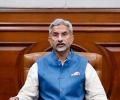
Reacting to the Congress leader's remarks, Jaishankar tweeted that the change in the Indian Foreign Service is a reflection of confidence.

Finance Minister Nirmala Sitharaman announced that India is set to introduce a new, more investor-friendly bilateral investment treaty (BIT) framework, which is expected to receive Cabinet approval shortly, aiming to provide sharper protection for investors from both sides.

The Indian government has notified the Legal Metrology (Indian Standard Time) Rules, 2026, establishing IST as the sole reference for all official purposes nationwide. These rules, effective in 180 days, aim to synchronise digital systems, reduce reliance on foreign time sources, and enhance coordination across critical sectors like banking, railways, and telecommunications.

Mumbai International Airport is set to reduce 265 weekly international flights from October 25 to facilitate the redevelopment of Terminal 1. This move, impacting 46 airlines including IndiGo and Air India, has raised concerns among carriers and global aviation bodies like IATA, who advocate for collaborative planning over mandated relocations.

Banking services across India, particularly at public sector banks, are set to be disrupted for three days starting Monday due to a nationwide strike by bank unions. The strike, called by the United Forum of Bank Unions (UFBU), is primarily to press for a five-day working week and other demands, despite the finance ministry's appeal for dialogue.

Former Chief Economic Adviser Krishnamurthy V Subramanian outlines India's strategy to become a USD 55 trillion economy by 2047. The plan hinges on leveraging its young demographic in AI, dominating sunrise sectors like space and defence tech, attracting FDI, and achieving sustained 8% GDP growth.

Moody's Ratings has sharply increased India's GDP growth forecast for fiscal 2026-27 to 7 per cent, making it the fastest among G20 economies, driven by economic resilience despite the Middle East conflict. However, the agency flagged significant inflation risks stemming from elevated oil prices and potential El Nino disruptions.

The GST Council, chaired by Finance Minister Nirmala Sitharaman, has begun deliberations on significant reforms, including decriminalising nine offences, softening provisions for 24, and raising the threshold for criminal prosecution to Rs 5 crore. The proposed changes also include scrapping the arrest powers of GST officers and introducing an 'invoice matching system' to combat fake input tax credit claims, aiming for a trust-based taxation approach and enhanced ease of doing business.
Indian benchmark indices, Sensex and Nifty, traded marginally higher in early trade despite the US Federal Reserve's recent rate hike and indications of further tightening, with the National Stock Exchange's much-anticipated Rs 22,569-crore IPO also opening for subscription.

Tewolde Gebremariam, a seasoned aviation professional with extensive experience at Ethiopian Airlines, has been named the new Chief Executive Officer and Managing Director of Air India. He is tasked with leading the airline's ambitious five-year transformation plan, Vihaan.AI, aimed at achieving significant growth and profitability, marking him as the second foreign national to helm Air India under Tata Group ownership.

"Pressure on the current account is a temporary problem. Sooner rather than later, our external sector will improve," said RBI Governor Sanjay Malhotra.

India's balance of payments (BoP) recorded an $8.1 billion deficit in the first quarter of 2026-27 (Q1FY27), a significant increase from a $4.5 billion surplus in the corresponding period of the previous year, primarily driven by a sharp reversal in portfolio flows.

Indian benchmark indices, Sensex and Nifty, saw an early rebound after significant losses, driven by value buying, though elevated oil prices and anticipation of the US Federal Reserve's policy decision tempered gains. Track Sensex, Nifty on September 16.

The Bill proposes replacing employment-based Green Card preferences with a points-based immigration framework.

When it pretends to be deaf, a situation can snowball into something it cannot contain. The government cannot dismiss public anger merely because protests are inconvenient or politically embarrassing, asserts Ramesh Menon.

Finance Minister Nirmala Sitharaman announced that the Goods and Services Tax (GST) Council's October 7 meeting will focus on 'GST 2.0' process reforms, including e-invoicing and input tax credit rules, while also addressing complex issues surrounding the taxation of the digital economy and cryptocurrency.

Left parties have strongly condemned the government's decision to impose charges on UPI payments exceeding Rs 2,000, with CPI General Secretary D Raja alleging the move was made under "US pressure" to favour foreign payment companies. Both CPI and All India Forward Bloc demand the withdrawal of this "anti-people decision," arguing it burdens consumers and merchants while undermining UPI's role as a public digital infrastructure. They highlight concerns that the charges weaken India's digital sovereignty and serve commercial interests of foreign corporations like Visa and Mastercard.

It is important to understand that the rupee's appreciation, driven by the 2013 special swap scheme, reduced India's import costs for petroleum, oil, and gold, points out Dr Ashwani Mahajan, National Co-Convenor, Swadeshi Jagaran Manch.
Indian benchmark indices Sensex and Nifty rebounded on Wednesday, driven by a decline in crude oil prices below USD 100 per barrel and optimism surrounding a potential de-escalation of the conflict in West Asia.

Indian benchmark indices, Sensex and Nifty, experienced a significant downturn, with Sensex tanking 778 points and Nifty closing at a five-month low, driven by surging crude oil prices, geopolitical tensions, and fears of further interest rate hikes by major central banks.

The Reserve Bank of India (RBI) has prematurely closed its swap facility for foreign currency non-resident (bank) deposits, FCNR(B), one month ahead of schedule, after banks mobilised $52.3 billion under the scheme by August 13, indicating sufficient foreign currency reserves.

The Finance Ministry has clarified that the 0.4 per cent Merchant Discount Rate (MDR) on UPI transactions above Rs 2,000, effective October 15, is not expected to increase cash transactions or cause inflation. The ministry also dismissed allegations of US pressure influencing the decision, asserting that the policy aims to promote RuPay credit cards within the UPI ecosystem, and a monitoring mechanism will ensure the MDR burden is not passed on to consumers.

At a valuation of around Rs 10 trillion, Tata Sons would rank among India's 10 largest listed companies and could qualify for inclusion in key indices such as the Nifty 50, Sensex and the Nifty 100.
